What is a Restricted Grant and How to Handle It? – A Nonprofit Guide

Nonprofit organizations often receive grants and donations to support specific programs, projects, and community initiatives. While this funding helps organizations advance their missions, it can also come with restrictions on how and when the money may be used.
Restricted grants for nonprofits are funds provided with donor- or grantor-imposed limitations on their use, timing, or purpose. Organizations must understand these requirements, track eligible expenses, maintain accurate financial records, and fulfill applicable reporting obligations.
Managing restricted grants effectively helps nonprofits maintain financial transparency, strengthen donor relationships, and demonstrate accountability.
In this guide, we’ll explain what restricted grants are, how they differ from unrestricted funding, how nonprofit organizations should account for them, and how to improve restricted grant tracking and reporting.
What Is a Restricted Grant?
A restricted grant is financial support awarded to a nonprofit organization with specific requirements governing how or when the funding may be used.
These requirements are typically documented in a grant agreement, award letter, or other communication from the funding organization.
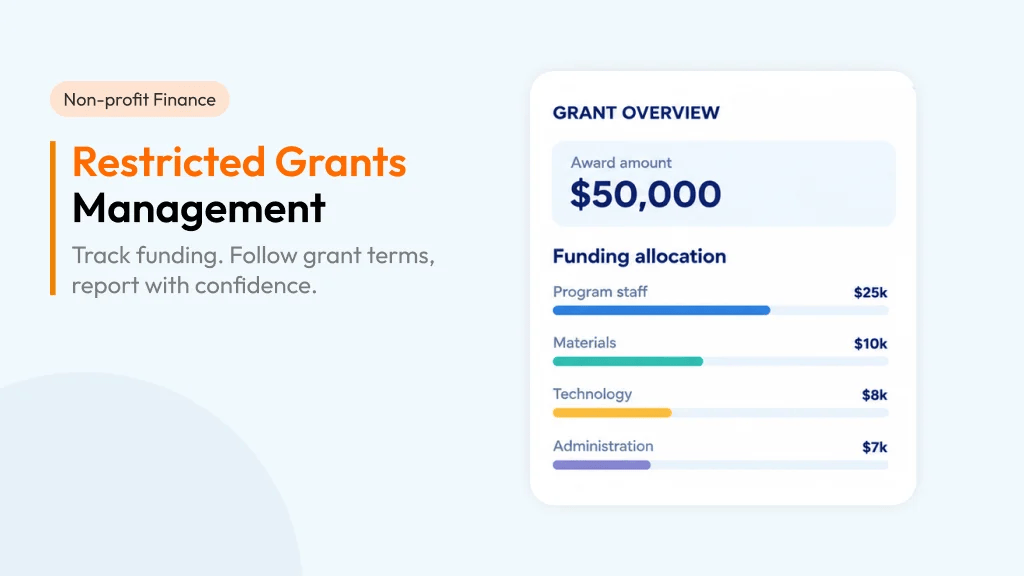
For example, a foundation may provide a $50,000 grant to support an after-school education program. If the grant agreement specifies that the money can only be spent on eligible program activities, the nonprofit must track expenses against those requirements.
The organization may need to maintain documentation showing:
- The original grant amount.
- The approved program or purpose.
- Eligible and ineligible expenses.
- Funding and spending deadlines.
- Amounts spent and remaining balances.
- Financial and program reporting requirements.
Not every grant is accounted for in the same way. The accounting treatment depends on the substance of the agreement, including whether the funding represents a contribution, an exchange transaction, or a conditional award.
Understanding these distinctions is an important part of restricted grant accounting for nonprofits.
Restricted Grants vs. Unrestricted Grants
Nonprofits receive both restricted and unrestricted funding. The primary difference is whether the donor has imposed limitations on the contribution.
| Feature | Restricted Grants | Unrestricted Grants |
| Purpose | Subject to donor- or grantor-imposed requirements | Generally available for permitted organizational needs |
| Spending flexibility | Limited by applicable restrictions | Greater flexibility |
| Tracking | Requires monitoring of applicable grant restrictions | Requires normal accounting and financial controls |
| Reporting | May require grant-specific reports | Generally included in regular organizational reporting |
| Example | A grant designated for a youth education program | A general operating contribution without donor-imposed restrictions |
Unrestricted contributions can generally support expenses such as staffing, administrative operations, technology, and other mission-related needs.
Restricted grants must be managed according to their specific terms.
For example, a nonprofit receiving $25,000 for a community health initiative cannot automatically redirect that funding toward unrelated operating expenses.
If changes become necessary, the organization should review the grant agreement and obtain any required approval from the funder.
Understanding the difference between restricted and unrestricted grants is essential for accurate nonprofit financial management.
Types of Restricted Grants for Nonprofits
Restrictions can vary depending on the donor, funding organization, and terms of the award.
1. Purpose-Restricted Grants
Purpose-restricted grants are provided for a designated activity, program, or initiative.
Examples include:
- Funding for educational scholarships.
- Grants supporting food assistance programs.
- Donations designated for medical equipment.
- Contributions for community development projects.
- Funding for a specific research initiative.
A nonprofit receiving a purpose-restricted grant must track spending to ensure that expenses comply with the approved purpose.
2. Time-Restricted Grants
Time-restricted grants or contributions contain donor-imposed limitations relating to when funds may be used or when a restriction may be satisfied.
For example, a donor may provide funding in the current year but specify that the contribution cannot be used until the following year.
The organization must document the restriction and account for it appropriately.
3. Endowment-Related Restrictions
Some donors establish endowments that require the original gift amount to be maintained for a specified duration or in perpetuity.
Depending on the agreement and applicable law, investment earnings may be available for designated activities.
Endowment accounting can involve additional legal and financial reporting requirements. Nonprofits should review donor agreements and consult qualified accounting professionals when necessary.
Understanding Current Nonprofit Accounting Terminology
Under current U.S. Generally Accepted Accounting Principles (GAAP), nonprofit organizations generally present net assets in two categories:
- Net assets with donor restrictions: Resources subject to donor-imposed restrictions.
- Net assets without donor restrictions: Resources not subject to donor-imposed restrictions.
The older classifications of temporarily restricted and permanently restricted net assets are no longer the standard financial statement presentation under current U.S. GAAP.
However, organizations must still distinguish the nature of restrictions when tracking and reporting their financial activity.
For a broader explanation, read our guide to GAAP accounting for nonprofits: https://www.cougarmtn.com/blog/the-importance-of-gaap-accounting-for-nonprofits/
How Should Nonprofits Account for Restricted Grants?
Accurate restricted grant accounting requires organizations to understand funding agreements, maintain appropriate records, and monitor financial activity throughout the grant period.
The following steps provide a practical framework.
Step 1: Review the Grant Agreement
Before recording or spending grant funds, review the agreement carefully. Identify the grant amount; approved programs and activities; eligible expense categories; funding and spending periods; matching requirements, if applicable; reporting deadlines; requirements for modifying the budget; and requirements for unused funds. Documenting these details helps finance teams establish appropriate tracking procedures.
Step 2: Determine the Appropriate Accounting Treatment
Not all grants are recognized as revenue in the same way. Some grants are contributions, while others may represent exchange transactions. Contributions may also contain conditions that affect when revenue is recognized. For conditional contributions, revenue recognition generally depends on whether the relevant conditions have been substantially met. Finance teams should evaluate the agreement under applicable accounting standards before recording the award.
Step 3: Establish Grant-Level Tracking
Each grant should have a clearly identifiable record within the organization’s accounting process. Depending on the system, this may involve fund identifiers, grant or project codes, department or program classifications, restricted funding categories, and separate budget records. These classifications help organizations connect funding sources with related expenses and reports.
Step 4: Track Eligible Expenses
Nonprofits should monitor expenses against the approved grant budget. For each transaction, maintain supporting documentation such as vendor invoices, payroll records, expense receipts, purchase approvals, allocation calculations, and other relevant financial records. Regular expense reviews help identify incorrect classifications and potential budget overruns.
Step 5: Reconcile Grant Balances
Grant balances should be reviewed and reconciled regularly. Compare grant tracking records with the general ledger and investigate any differences. Review original funding amounts, recorded revenue and receipts, eligible expenses, remaining budget availability, outstanding commitments, and applicable restrictions. Consistent reconciliation supports accurate grant reporting and financial oversight.
Step 6: Prepare Grant Reports
Many funding organizations require periodic financial reports. These reports may include grant revenue or funding received, expenses by approved category, remaining grant balances, budget-to-actual comparisons, supporting documentation, and program outcomes or milestones. Organizations should reconcile the information before submitting reports to funders.
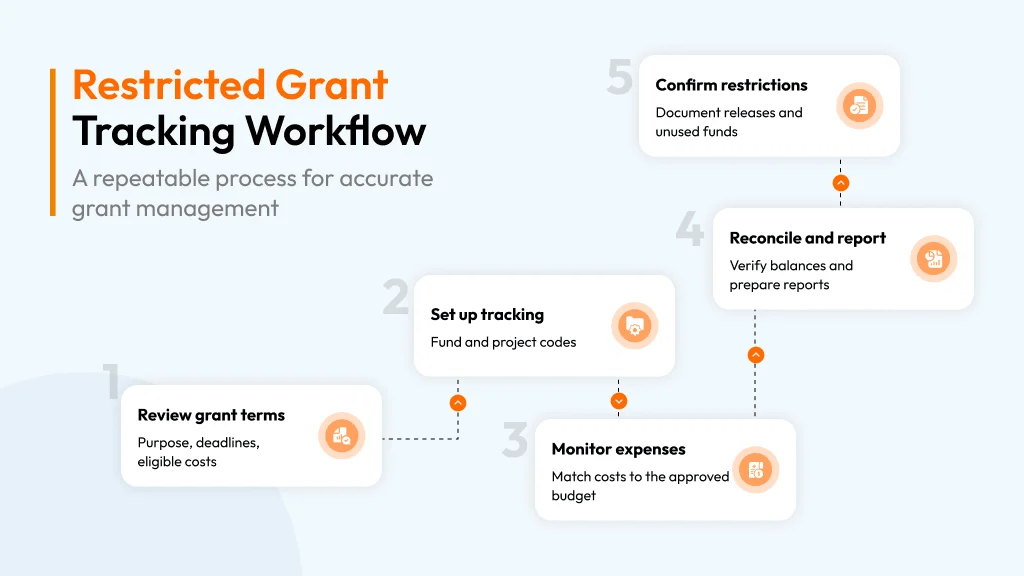
Step 7: Evaluate When Restrictions Are Satisfied
When donor-imposed restrictions are satisfied, the nonprofit should record any required release or reclassification in accordance with applicable accounting standards. For example, a purpose restriction may be satisfied when qualifying expenses are incurred for the designated program. The accounting treatment depends on the agreement and relevant guidance. Nonprofits should not assume that all unspent grant funds automatically become unrestricted when a project ends.
Restricted Grant Accounting Example
Consider a nonprofit organization that receives a $50,000 grant to operate a community education program.
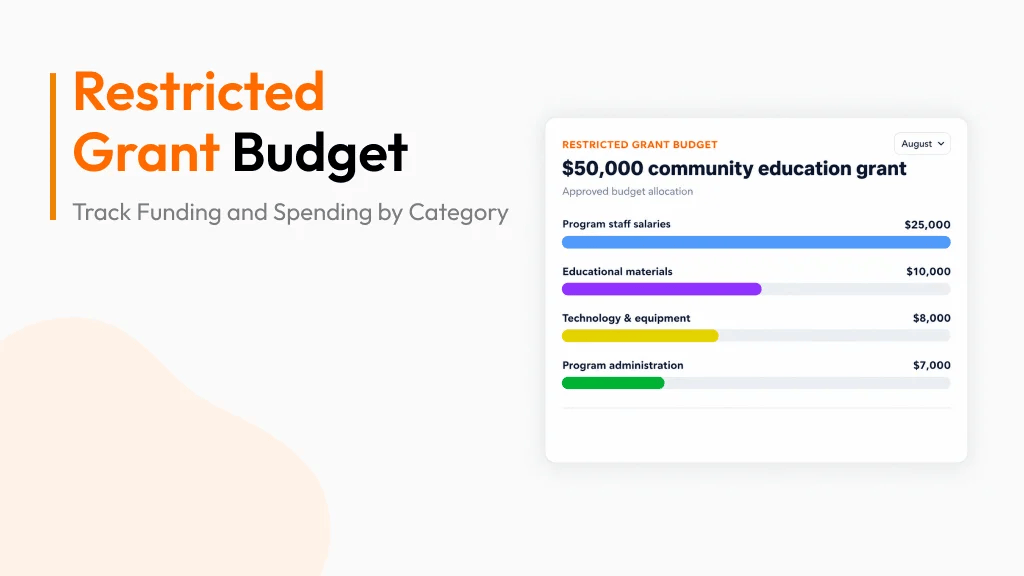
The approved grant budget includes:
| Expense Category | Approved Budget |
| Program staff salaries | $25,000 |
| Educational materials | $10,000 |
| Technology and equipment | $8,000 |
| Program administration | $7,000 |
| Total | $50,000 |
After several months, the organization records the following eligible expenses:
| Expense Category | Amount Spent |
| Program staff salaries | $12,000 |
| Educational materials | $4,000 |
| Technology and equipment | $2,000 |
| Program administration | $0 |
| Total Spent | $18,000 |
Remaining unspent grant budget: $50,000 − $18,000 = $32,000
The nonprofit should continue monitoring the remaining budget and ensure that future expenses comply with the grant agreement.
This example is illustrative. The unspent budget amount does not necessarily equal the amount reported as restricted net assets or a liability, because financial statement treatment depends on the grant’s conditions and applicable accounting requirements.
Common Challenges in Managing Restricted Grants
1. Tracking Multiple Grants
Organizations may receive funding from several foundations, government agencies, and individual donors. Each grant may have different requirements. Managing these restrictions without clear financial classifications can make it difficult to determine which expenses belong to each award.
2. Maintaining Accurate Grant Balances
When financial data is spread across multiple spreadsheets or disconnected systems, discrepancies can arise. Organizations may struggle to determine how much funding has been spent, committed, or remains available. Regular reconciliation and centralized financial records can help reduce these issues.
3. Meeting Reporting Deadlines
Grant agreements may require monthly, quarterly, or annual reporting. Missing deadlines or submitting inaccurate information can create compliance issues and affect relationships with funding organizations. A structured reporting calendar helps teams stay organized.
4. Preventing Ineligible Spending
Expenses must be reviewed against the relevant grant conditions. Charging an unrelated expense to a restricted grant may require correction and could lead to other consequences under the agreement. Clear approval procedures and expense classifications help strengthen financial controls.
5. Managing Grant Information Across Spreadsheets
Spreadsheets can support basic grant tracking, but maintaining multiple files may increase manual work. Common challenges include duplicate data entry, formula errors, version-control problems, difficult reconciliations, limited visibility across programs, and time-consuming report preparation. Organizations managing complex grant portfolios may benefit from a more integrated accounting approach.
For additional guidance, explore our article on fund tracking for nonprofits: https://www.cougarmtn.com/blog/fund-tracking-for-nonprofits/
Best Practices for Restricted Grant Tracking
Maintain Centralized Grant Documentation
Store grant agreements, approved budgets, amendments, financial reports, and supporting documentation in an organized location. This helps authorized staff access the information needed for financial reviews and reporting.
Use Consistent Fund and Project Classifications
Create a standard approach to identifying funding sources, programs, and expenses. Consistent classifications can make financial reports easier to prepare and review.
Monitor Budget-to-Actual Performance
Compare recorded expenses with approved budgets throughout the grant period. Investigate significant variances and address potential issues before reporting deadlines.
Establish Internal Review Procedures
Require appropriate approvals for expenses, budget changes, and financial reports. Separating transaction entry, authorization, and review responsibilities where practical can help improve internal controls.
Conduct Regular Reconciliations
Reconcile grant records with the general ledger and supporting documentation. Regular reviews can help identify incorrect classifications and missing transactions.
Prepare for Grant Reporting in Advance
Maintain a reporting calendar and assign responsibilities to finance and program teams. Preparing reports throughout the grant period is generally more efficient than collecting information only when deadlines approach.
How Fund Accounting Software Helps Nonprofits Manage Restricted Grants
As nonprofits expand their programs and funding sources, they may need more structured financial management tools.
Nonprofit fund accounting software helps organizations organize financial information by fund, program, or other relevant classification.

Depending on the system’s capabilities, fund accounting software can support:
- Tracking financial activity across multiple funds.
- Monitoring program budgets and expenses.
- Preparing financial statements and reports.
- Reviewing transactions and account balances.
- Maintaining financial records for audits.
- Supporting internal financial controls.
These capabilities can help nonprofit finance teams reduce manual reconciliation work and improve visibility into financial activity.
Why Consider Denali Fund?
Denali Fund nonprofit fund accounting software from Cougar Mountain Software is designed for organizations that need fund-level accounting and financial reporting capabilities.
Nonprofits evaluating Denali Fund can review how its available features support their needs for fund-level financial tracking, budget management, financial reporting, transaction visibility, and accounting workflows.
The right accounting solution should align with an organization’s funding structure, grant requirements, reporting responsibilities, and internal controls.
For organizations comparing different options, explore accounting software for nonprofits to learn more about nonprofit financial management solutions.
Internal links: Denali Fund — https://www.cougarmtn.com/denali-fund/ ; Nonprofit software — https://www.cougarmtn.com/nonprofit-software/
Frequently Asked Questions About Restricted Grants
What is a restricted grant for a nonprofit?
A restricted grant is funding provided to a nonprofit with specific donor- or grantor-imposed limitations. These restrictions may define how the funds can be spent, when they may be used, or which activities they must support.
What is the difference between restricted and unrestricted grants?
Restricted grants contain donor-imposed limitations on their use or timing. Unrestricted contributions do not contain those donor-imposed limitations, providing organizations with greater flexibility, subject to other applicable requirements.
How do nonprofits track restricted grant funds?
Nonprofits typically track restricted grants by documenting grant terms, identifying eligible expenses, maintaining fund or project classifications, monitoring budgets, reconciling transactions, and preparing required reports.
Can restricted grant funds be used for operating expenses?
Restricted grant funds may be used for operating expenses only when those expenses are permitted under the grant agreement and applicable requirements. For example, a grant may allow a specified amount for administrative costs. Expenses outside the approved terms may require prior authorization.
What happens to unused restricted grant funds?
The treatment of unused funds depends on the grant agreement and applicable requirements. Funds may need to be returned, carried forward with approval, or handled according to another provision in the agreement.
Are restricted grants considered revenue?
Some restricted grants are recognized as contribution revenue, while others may be conditional contributions or exchange transactions. Revenue recognition depends on the agreement’s terms and applicable accounting standards.
Do nonprofits need separate bank accounts for restricted grants?
Not every restricted grant requires a separate bank account. Whether separate banking arrangements are necessary depends on the grant terms, legal requirements, and the organization’s policies. Nonprofits must still maintain records sufficient to identify and monitor restricted financial activity.
What is the best way to manage multiple restricted grants?
A structured grant-management process that combines clear accounting classifications, regular reconciliations, budget monitoring, and reliable reporting can help organizations manage multiple awards. Fund accounting software may support these processes when configured appropriately.
Conclusion
Restricted grants play an important role in helping nonprofits fund programs, expand services, and achieve their missions.
However, accepting restricted funding also requires organizations to understand donor requirements, monitor eligible expenses, maintain accurate accounting records, and meet reporting obligations.
By implementing consistent grant-tracking procedures and strengthening financial controls, nonprofits can improve transparency and demonstrate responsible stewardship of donor funds.
For organizations managing multiple funds and complex reporting requirements, appropriate fund accounting tools can help simplify financial management and improve visibility into restricted funding.
Explore Denali Fund to learn how fund accounting software can support your nonprofit’s financial management needs.
fund accounting, Nonprofit, Restricted fund, Restricted Grant