Best Nonprofits Accounting Software in 2026
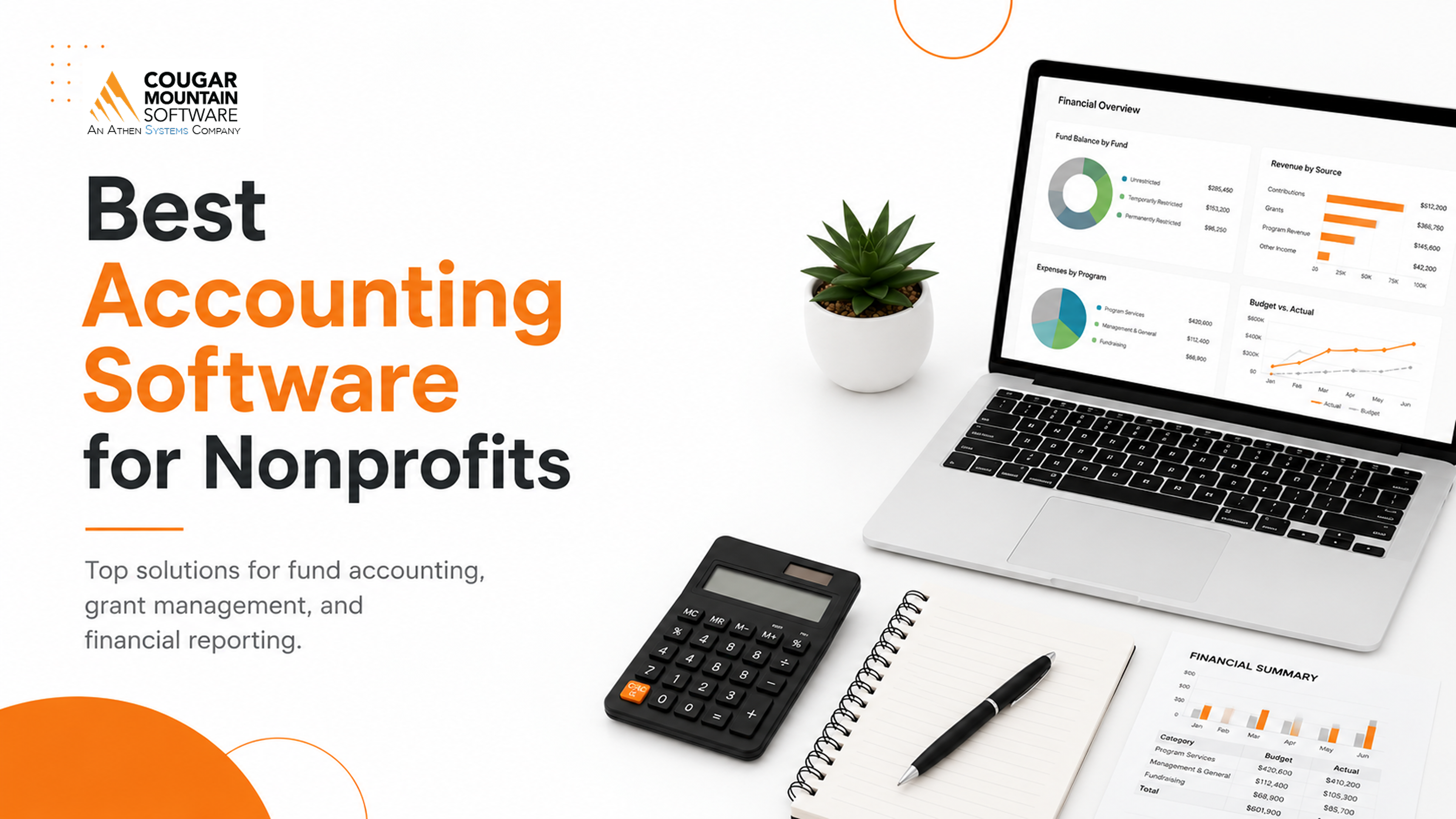
Choosing the best nonprofit accounting software is an important decision for any nonprofit organization. Nonprofits often need to manage multiple funds, restricted and unrestricted contributions, grants, programs, budgets, and detailed financial reporting.
The right nonprofit accounting software can help your finance team manage these requirements, reduce manual work, and maintain accurate financial records.
But which accounting software is right for your organization?
In this guide, we compare five nonprofit accounting software options and explain what to consider before choosing a system. We also compare QuickBooks with dedicated fund accounting software and explain when a nonprofit may benefit from a more specialized solution.
For organizations looking for dedicated nonprofit financial management capabilities, Cougar Mountain’s nonprofit accounting software and Denali Fund are worth evaluating.
The 5 Best Nonprofit Accounting Software in 2026-2027
If you are comparing accounting software for your nonprofit, these five solutions are worth considering based on different organizational needs.
| Software | Best For | Fund Accounting | Grant Tracking | Best Fit |
| Cougar Mountain Denali Fund | Nonprofit fund accounting | Yes | Yes | Small and midsize nonprofits |
| QuickBooks | Basic accounting | Limited | Limited | Smaller nonprofits |
| Blackbaud Financial Edge NXT | Complex nonprofit finance | Yes | Yes | Larger nonprofits |
| Sage Intacct | Growing organizations | Yes | Yes | Growing nonprofits |
| Aplos | Small nonprofits and churches | Yes | Yes | Smaller organizations |
The best option depends on your organization’s size, number of funds, reporting requirements, grant activity, budget, and expected growth.
1. Cougar Mountain Denali Fund
Cougar Mountain Denali Fund is a nonprofit accounting software built for organizations that need more than basic general ledger accounting. It provides dedicated fund accounting capabilities to help nonprofits manage multiple funds, programs, budgets, grants, and financial reporting within one accounting system.
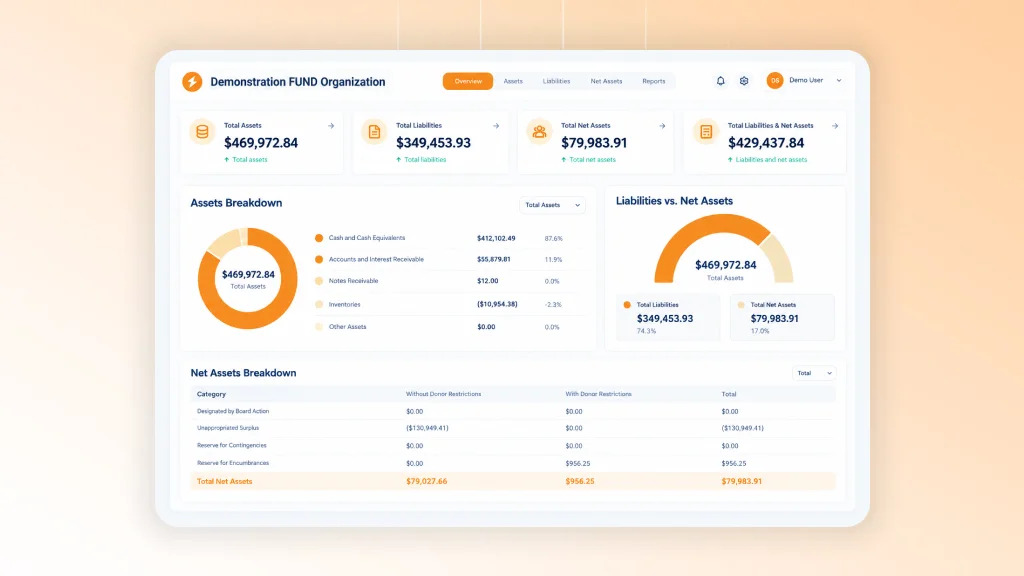
Instead of treating all financial activity as one pool of money, Denali Fund helps organizations maintain visibility into where funds come from, how they can be used, and how they are being spent. This can be especially useful for nonprofits
Denali Fund supports areas such as:
- Fund accounting
- Financial reporting
- Budget management
- User rights
- Audit trails
- Fund tracking
- General ledger
- Accounts payable
- Accounts receivable
- Reporting and analysis
These capabilities can help finance teams reduce the need to maintain separate spreadsheets for fund balances, budgets, and financial reporting. They can also provide a more structured way to manage financial information as the organization adds funds, programs, grants, users, or reporting requirements.
Who Should Consider Denali Fund?
Denali Fund may be worth evaluating for:
- Small nonprofits
- Midsize nonprofits
- Community organizations
- Associations
- Foundations
- Religious organizations
- Organizations managing restricted funds
- Nonprofits that have outgrown basic accounting software
If your organization needs a dedicated nonprofit accounting system, Denali Fund is one option to evaluate.
2. QuickBooks
QuickBooks is widely used by small organizations because of its familiarity and general accounting capabilities.
For nonprofits with relatively straightforward financial requirements, it can be a practical option.
However, as organizations add more funds, programs, grants, and reporting requirements, they should evaluate whether their current setup continues to meet their needs.
Who Is QuickBooks Best For?
QuickBooks may be suitable for nonprofits with:
- Simple accounting requirements
- A small number of funds
- Limited reporting complexity
- Basic budgeting requirements
3. Blackbaud Financial Edge NXT
Blackbaud Financial Edge NXT is designed for nonprofit financial management and can be relevant for larger organizations with more complex financial requirements.
It may be appropriate for organizations with:
- Complex accounting structures
- Larger finance teams
- Extensive reporting requirements
- Multiple programs and funding sources
Organizations should compare functionality, implementation requirements, pricing, and support before making a decision.
4. Sage Intacct
Sage Intacct is a cloud financial management platform used by organizations that require advanced accounting and reporting capabilities.
It may be worth evaluating for growing nonprofits that need:
- Advanced reporting
- Multi-dimensional accounting
- Scalability
- Integrations
- More sophisticated financial processes
5. Aplos
Aplos is focused on smaller nonprofits and churches and provides accounting and financial management capabilities for organizations in these segments.
It may be suitable for:
- Small nonprofits
- Churches
- Smaller organizations
- Organizations with relatively straightforward accounting requirements
Before selecting any platform, compare its fund accounting, reporting, budgeting, grant tracking, integrations, and scalability against your requirements.
What to Look for in Nonprofit Accounting Software
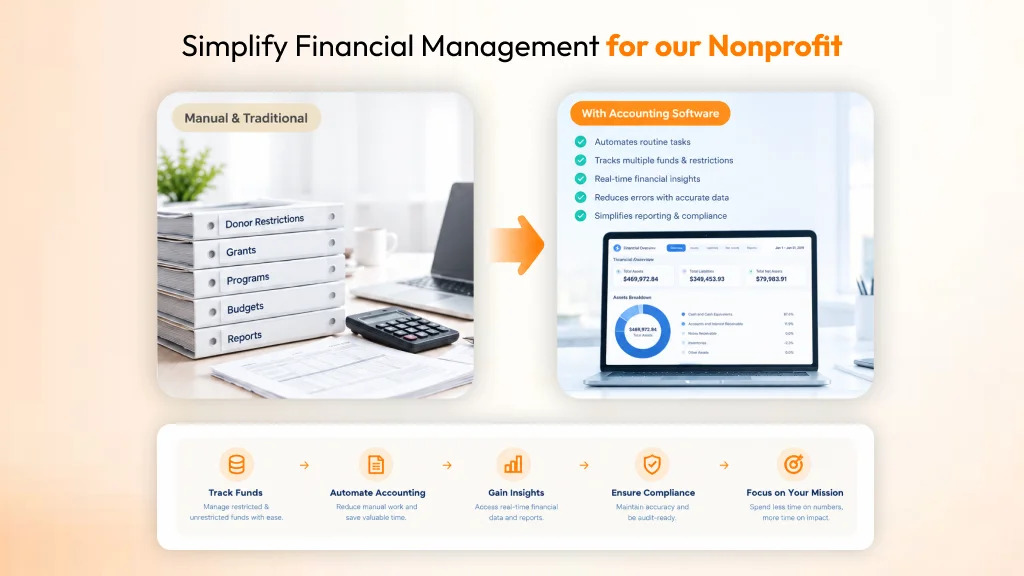
Nonprofits have accounting requirements that can be different from those of traditional businesses. A nonprofit may need to know not only how much money it has, but also which fund the money belongs to, whether it is restricted, and how it has been spent.
Fund Accounting
Fund accounting allows nonprofits to organize financial activity according to the purpose or restrictions associated with each fund.
Your organization may manage:
- General operating funds
- Restricted donor funds
- Grant funds
- Program funds
- Capital funds
- Endowment funds
If your organization manages multiple funds, look for nonprofit fund accounting software that can track financial activity and generate reports by fund.
Grant Tracking
Grant-funded organizations need to track grant income and expenses accurately.
Your accounting system should make it easier to monitor:
- Grant budgets
- Grant revenue
- Eligible expenses
- Program expenses
- Funding restrictions
- Remaining balances
If you also need donor and CRM functionality, Cougar Mountain offers NeonCRM integration and services.
Financial Reporting
Nonprofits need financial information for management, boards, auditors, and other stakeholders.
Common reports include:
- Statement of Financial Position
- Statement of Activities
- Statement of Cash Flows
- Budget vs. Actual
- Fund reports
- Grant reports
- General ledger reports
Look for software that lets you generate the reports you need without rebuilding information manually in spreadsheets.
Budget Management
Budgeting helps nonprofits compare planned spending with actual financial activity.
Look for capabilities such as:
- Fund budgets
- Program budgets
- Annual budgets
- Budget vs. actual reporting
- Variance analysis
User Permissions and Audit Trails
As organizations grow, more employees may need access to financial information.
User permissions can help control what different employees can view or change, while audit trails can help finance teams review changes to financial records.
Scalability
Your accounting system should be able to support your organization as it grows.
Consider whether it can handle:
- Additional funds
- More users
- More grants
- New programs
- Increased transaction volume
- More complex reporting
How to Choose the Right Nonprofit Accounting Software
Before choosing a system, evaluate your current financial processes and identify where your accounting team spends the most time.
Evaluate Your Fund Structure
List the funds your organization currently manages.
Ask:
- How many funds do we have?
- Which funds are restricted?
- Do programs require separate budgets?
- Do we need fund-level reporting?
- Are spreadsheets being used to track funds?
If your team spends significant time manually reconciling fund information, dedicated fund accounting software may be worth considering.
Review Your Grant Requirements
If grants are an important source of funding, determine how you currently track grant budgets and expenses.
Consider:
- Number of active grants
- Grant restrictions
- Grant budgets
- Reporting requirements
- Grant-related expenses
Identify Your Reporting Requirements
List the reports your finance team prepares each month, quarter, and year.
Then identify which reports require manual spreadsheet work.
This can help you determine whether your current system is providing the reporting capabilities you actually need.
Consider Total Cost
Don’t compare software based only on the subscription or license price.
Consider:
- Software costs
- Implementation
- Training
- Support
- Data migration
- Additional users
- Integrations
Plan for Growth
Your organization may have simple requirements today but significantly more complex requirements in a few years.
Choose a system that can support your expected growth rather than only your current accounting structure.
Which Nonprofit Accounting Software Is Best for Your Organization?
There is no single system that is right for every nonprofit. Your organization should prioritize the capabilities that match its size, financial structure, and operational needs.
For Fund Accounting
If fund accounting is your primary requirement, evaluate systems designed to manage multiple funds, restrictions, programs, and fund-level reporting. Denali Fund is designed around fund accounting requirements and is worth considering for organizations with these needs.
For Basic Accounting
Smaller nonprofits with straightforward accounting requirements may find a general accounting platform sufficient. However, consider your expected growth before choosing a system.
For Larger Nonprofits
Larger organizations may require more sophisticated financial reporting, integrations, user management, and accounting structures.
For Growing Organizations
Growing nonprofits should consider whether their accounting system can accommodate additional funds, programs, grants, users, and transactions.
For Small Nonprofits and Churches
Smaller organizations may prioritize affordability, ease of use, simple reporting, and straightforward implementation.
Signs Your Nonprofit Has Outgrown Its Accounting Software
Your organization may need to evaluate a new accounting system if you experience several of these problems.
- Too Many Spreadsheets
If your team constantly exports accounting data into spreadsheets to track funds, grants, or budgets, your current system may not be meeting your needs. - Manual Financial Reporting
If monthly or board reports require significant manual work, stronger reporting capabilities could reduce the workload. - Difficulty Tracking Funds
If fund balances are difficult to reconcile or financial information is spread across multiple spreadsheets, dedicated fund accounting may be worth considering. - Limited User Controls
As your organization grows, more employees may need access to financial information. Appropriate user permissions can help maintain financial controls. - Increasing Audit Preparation Work
If audit preparation requires manually assembling information from multiple spreadsheets and systems, a more structured accounting environment may simplify the process. If these challenges sound familiar, explore Cougar Mountain’s nonprofit accounting software.
Why Consider Cougar Mountain Denali Fund?
The right accounting software should help your organization manage its financial complexity rather than add more manual work. For nonprofits managing multiple funds and programs, Denali Fund provides a dedicated approach to fund accounting.
Organizations can use it to support areas such as:
- Fund management
- Financial reporting
- Budget management
- Financial controls
- User access
- Accounting operations
You can also review Cougar Mountain customer testimonials to learn more about customer experiences.
If you’re looking for a dedicated nonprofit accounting system, learn more about Denali Fund.
Ready to Choose the Right Nonprofit Accounting Software?
The right accounting system should do more than record transactions. It should help your organization manage funds, track financial activity, prepare reports, maintain financial controls, and support future growth.
If your nonprofit has outgrown basic accounting tools or relies heavily on spreadsheets to manage funds and reporting, Cougar Mountain Denali Fund is worth a closer look.
Explore Cougar Mountain’s nonprofit accounting solutions to see how dedicated fund accounting can give your team clearer financial visibility and more control over day-to-day accounting.
Frequently Asked Questions
- What is the best accounting software for nonprofits?
The best solution depends on your organization’s size, fund structure, reporting requirements, grants, budget, and growth plans. For organizations that require dedicated fund accounting, Denali Fund is one solution worth evaluating.
- What is the best fund accounting software for nonprofits?
Look for software that can manage multiple funds, restricted and unrestricted funding, program expenses, budgets, and fund-level reporting.
- Can nonprofits use QuickBooks?
Yes. Many smaller nonprofits use QuickBooks for basic accounting. However, organizations with increasingly complex fund accounting or reporting requirements should evaluate whether their current system remains suitable.
- What is the best QuickBooks alternative for nonprofits?
There is no single solution that is best for every organization. Nonprofits considering a QuickBooks alternative should compare fund accounting, reporting, grant management, scalability, implementation, and total cost. Denali Fund is one option organizations can evaluate.
- What features should nonprofit accounting software have?
Important capabilities include:
- Fund accounting
- Restricted fund tracking
- Grant tracking
- Budget management
- Financial reporting
- User permissions
- Audit trails
- General ledger
- Accounts payable and receivable
- Scalability
- What is fund accounting?
Fund accounting is an accounting method that separates financial resources according to their purpose, restrictions, or funding source. It helps nonprofits understand how money is received and spent across different funds and programs.